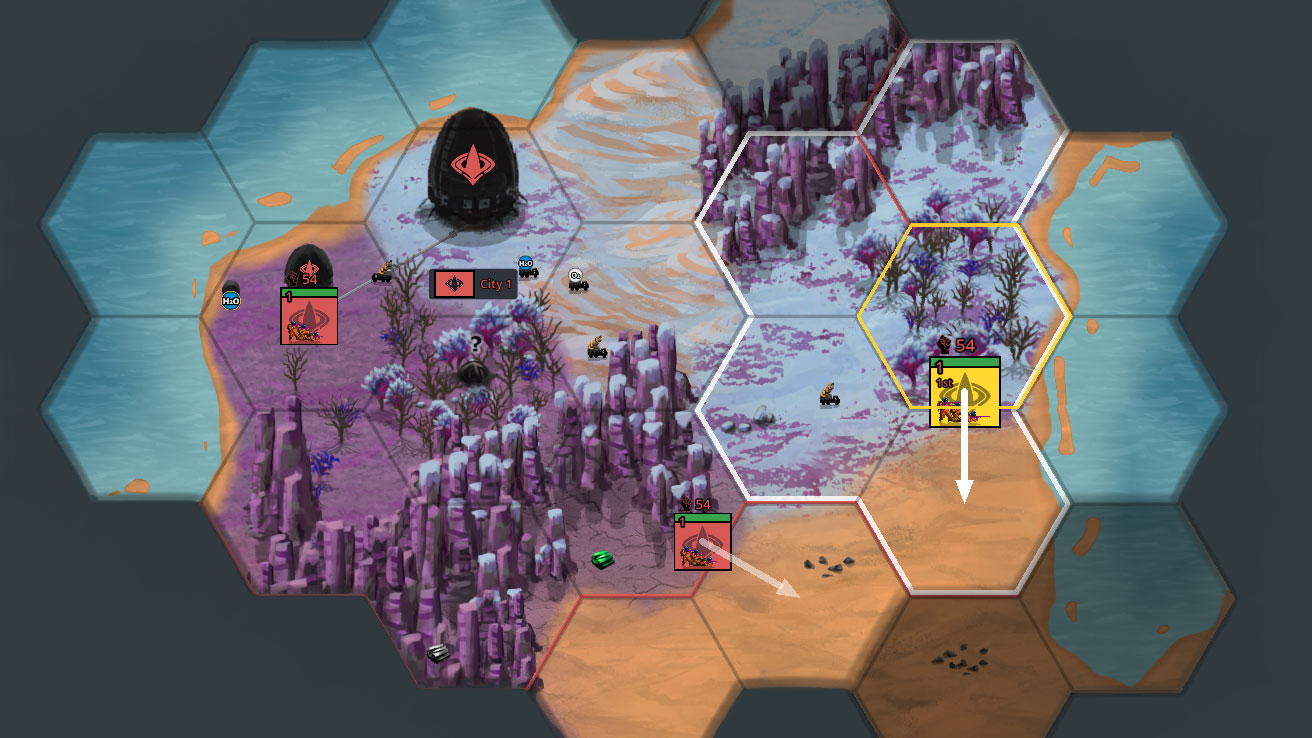
We love Shadow Empire’s logistics and varied worlds, the simultaneous turns in Dominions, and the design workshop in Alpha Centauri. The four cornerstones of our sci-fi 4X follow from those influences: WEGO turns, a unit designer, planets with different physical conditions, and logistics.
WEGO: everyone has a plan
A strategy game gives you plenty to think about during your own turn. Add five other players taking equally thoughtful turns, one after another, and the waiting soon adds up.
WEGO means everyone plans at the same time. You issue movement orders, work on designs and manage production while the other players do the same. Once everyone is ready, the game resolves those orders and you watch the movement and battles play out. There is still waiting for the last person to finish. But your planning time overlaps with theirs.
We pair this with autobattler combat. When armies meet, the battle plays out automatically: you watch the units you designed fight, without taking direct tactical control.
Simultaneous planning also brings uncertainty. You can see an enemy force and plan an attack, but the enemy has plans too. They might advance, hold their ground or leave before you arrive. You have to make a decision with the information available.
That commitment is why WEGO fits this game. By the time the first shot is fired, you have already decided what to build, where to send it and how to keep it supplied. Neither of you gets to revise the plan until the next turn. Watching the resolution is tense because your strategy is being put to the test.
Unit design: how big a tank do you need?
Take a tank. Its design starts with the iron triangle: mobility, firepower and armor. You want all three, but every component you add has a cost.
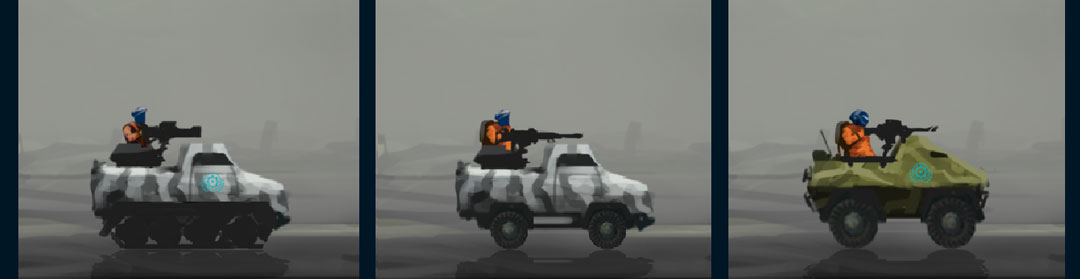
In our unit designer, you choose a chassis and fit it with components: tracks, an engine, a turret, weapons and armor. Fit a bigger gun and you add mass. Add more armor to keep the tank alive and it gets heavier again. With the same engine, that extra weight costs mobility. A more powerful engine can help, but it brings its own production and supply requirements.
The balance depends on what you need the tank to do. A tank built to break through enemy armor might justify a heavy gun and substantial protection. A vehicle intended to exploit an opening needs enough mobility to get there in time. Those roles emerge from the parts you choose.
Then your economy gets a say. How many of these tanks can your factories build, and can your trucks keep them supplied? You might be able to build an excellent tank and still be better served by several cheaper ones. That brings you back to a practical question: how big tank does this particular job need?
There is also the pleasure of making something yours. The components change the unit's appearance, and faction colors give the army a common identity. Watching a vehicle you assembled go into combat feels different from watching a standard tank selected from a list. Pymous's art has an important job here: making those choices visible.
Planets: a different world, a different strategy
A unit designer has little purpose if the same design is always the best choice. Different planets give you reasons to build different armies.
Gravity is one example. The same vehicle has more weight to move on a world with higher gravity, so the balance between armor and engine power changes. Mountains, rivers and the location of resource deposits shape where you can expand, and whether infantry, wheeled vehicles or walking mechs are best suited to the terrain.
Then there is the oxygen problem. On a breathable world, infantry get their air for free. On a world with very little oxygen, your cities and units may need equipment to extract it from the air. On a world without atmospheric oxygen, you have to produce it and deliver it wherever it is needed. Combustion engines need supplied oxygen too when the atmosphere cannot support them. Electric motors remove the engine's oxygen demand, but the crew still needs to breathe.
The same applies to water. On some worlds, you can drink straight from a river. On others, you need to find groundwater, extract moisture from the atmosphere or purify what you can collect.
Logistics: the nation behind the army
Imagine a battle gathering pace. Your artillery is firing shell after shell, and your tanks are burning fuel as they move into position. The trucks are already stretched getting ammunition and fuel to the front. You have enough to start this fight. Can you keep it going?
Every battle draws on the work of an entire nation. Behind every artillery battery are factories making ammunition, mines feeding those factories and drivers bringing the shells forward. You build and protect the supply network, and the game handles the individual deliveries.
The planet determines what you can obtain locally and what you have to carry. Your unit designs determine the ammunition and energy your army needs. Those choices keep making demands long after the factories have finished building your units.
With WEGO, you have to judge those demands before you know what your opponent has planned. More tanks could strengthen the attack, or stretch your supplies beyond what they can support. A smaller force might achieve more by cutting off the enemy's ammunition and fuel, but sending it away leaves fewer troops protecting your own supply line.
That is why we put logistics at the center of the game. We want choosing a planet, designing a tank and planning a battle to feel like parts of the same problem. The satisfaction comes when the army you imagined in the designer can actually sustain the campaign you built it for. And sometimes, making that possible starts with working out how much oxygen a truck can carry.
What do you think about these four cornerstones of our game?
Subscribe below and I'll email you when the next post is up.